


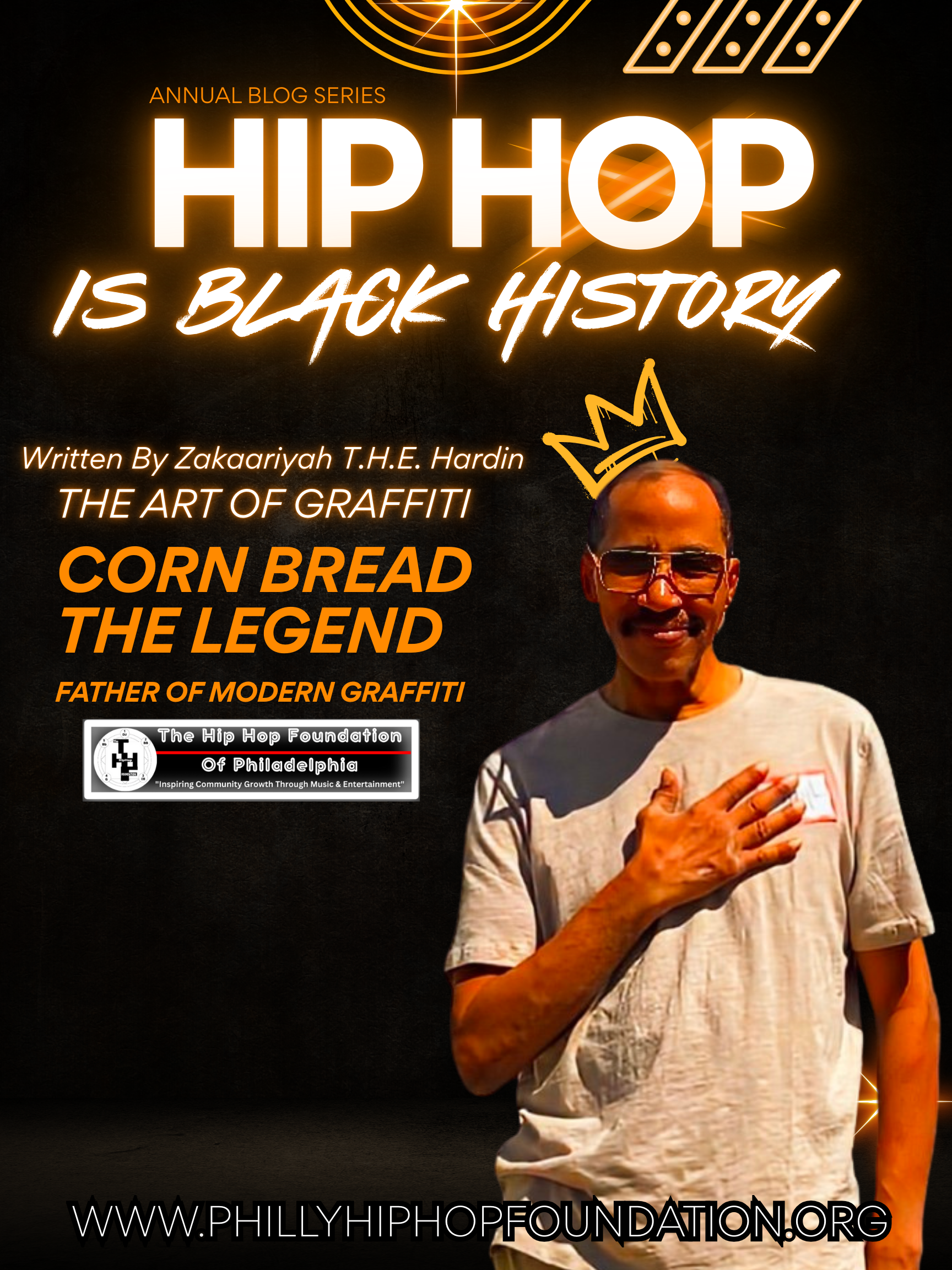
THE FIRST ELEMENT OF HIP HOP WAS BORN IN PHILLY
Hip Hop did not begin as a trend—it began as an invention. An answer to invisibility. Long before Hip Hop was a global industry, it was a survival language created by Black youth to say “I am here” in a world built to ignore them. One of the earliest and most powerful of those declarations came not through a microphone or a turntable, but through a name written boldly on walls. That name was Cornbread. Long before the Bronx was internationally recognized as the birthplace of Hip Hop culture, modern graffiti—also known as wall writing—was born in North Philadelphia, created by Darryl McCray, forever known as Cornbread the Legend. His work predates the commercial rise of Hip Hop and may very well be the first adopted element of Hip Hop culture, setting the visual and rebellious foundation that the culture still stands on today.
Darryl McCray grew up in North Philadelphia in the 1960s, a time when Black neighborhoods were heavily policed, underfunded, and culturally erased. As a young Black teenager navigating poverty, institutional neglect, and social confinement, McCray found power in something simple but radical—writing his name. While detained at Youth Development Center (YDC), he began tagging “Cornbread” as a way to stand out, to exist beyond the system trying to define him. The name itself came from a moment of youthful humor and self-definition—when asked what he wanted to eat, Darryl answered “cornbread,” and the nickname stuck. But what began as a nickname became a revolutionary signature.
“This was something the world had never seen before: a Black youth asserting authorship over public space without permission”-
Cornbread didn’t just write his name—he wrote himself into history. He took graffiti off bathroom walls and school desks and put it into the public landscape. He wrote “Cornbread” on city walls, buses, bridges, street signs, and buildings across Philadelphia, making his name unavoidable. This was something the world had never seen before: a Black youth asserting authorship over public space without permission. There were no crews yet, no competition for fame, no hip hop industry—just one young Black man saying “I exist, and you will see me.” That act alone changed visual culture forever.
Cornbread’s wall writing was not vandalism in the modern sense—it was a social declaration. He famously wrote “Cornbread Lives” on the side of a Philadelphia zoo elephant to prove to the media he was alive. It was believed he was killed by gang violence, but that was not the case. These weren’t random acts; they were statements. Cornbread’s work forced the city—and eventually the world—to confront the creativity, boldness, and humanity of Black youth. According to graffiti historians and scholars like Joe Austin, Jeff Chang (Can’t Stop Won’t Stop), and institutions such as the Smithsonian National Museum of African American History and Culture, Cornbread is widely recognized as the first modern graffiti writer.
What happened next is crucial to Hip Hop history. The idea of name-based wall writing traveled from Philadelphia to New York, influencing youth in the Bronx in the late 1960s and early 1970s. Writers like TAKI 183, Julio 204, Tracy 168, and others would later popularize tagging in New York, but they followed a blueprint already laid by Cornbread. The Bronx refined it, stylized it, expanded it—but Philadelphia birthed it. Just as DJ Kool Herc extended breakbeats in the Bronx, Cornbread extended identity across concrete in Philly. This is why graffiti is not a side note in Hip Hop—it is foundational.
“Graffiti stands as one of the original elements of Hip Hop culture—and arguably the first to be practiced independently at scale”-
Modern graffiti became the visual language of Hip Hop. Before rap records, before music videos, before radio play, graffiti gave Hip Hop its look, its attitude, and its presence. It taught the culture how to claim space, how to speak without permission, how to turn marginalization into art. Alongside DJing, emceeing, breakin’, and later beatboxing, graffiti stands as one of the original elements of Hip Hop culture—and arguably the first to be practiced independently at scale.
Ironically, the same city that once criminalized Cornbread’s work would later build an international reputation on wall art. Cornbread’s legacy directly influenced the creation of the Mural Arts Program of Philadelphia, which began in the 1980s as an anti-graffiti initiative but evolved into the largest public art program in the world. Today, Philadelphia is home to over 4,000 murals, more than any city globally. That transformation—from criminalization to celebration—traces directly back to Cornbread. Without his defiance, there is no mural movement. Without graffiti, there is no visual Hip Hop ecosystem.
“Cornbread The Legend is not just a graffiti pioneer—he is a Black history pioneer”-
Cornbread the Legend is not just a graffiti pioneer—he is a Black history pioneer. His work reshaped how cities engage art, how youth assert identity, and how Hip Hop culture understands visibility. Graffiti did what Black music has always done: it crossed borders, broke language barriers, and spoke truth from the margins. Today, graffiti-inspired design dominates advertising, fashion, digital art, and global street culture. What once got Cornbread arrested now gets corporations paid.
Hip Hop is Black history because it is Black invention. And modern graffiti is proof. Cornbread’s name on a wall became a global movement. His marker became a microphone. His defiance became culture. To be a Hip Hopper is to inherit that legacy—to understand that creativity is resistance and visibility is power. This Black History Month, we honor Cornbread the Legend, the father of modern graffiti, and recognize that before the world learned to hear Hip Hop, it learned to see it—written on the walls of Philadelphia.
Written By: Zakaariyah T.H.E. Hardin-